
Gold's post-2022 surge cannot be explained by war, Western investors, or traditional valuation models alone. The missing force is discreet central-bank demand.
Since the 2020/2021 pandemic, precious metals' prices have tracked upwards like many other assets. Inflation, geopolitical risks and market expectations are all partially blamed for the rising tide but, unlike equities or commodities, gold and silver have limited industrial use and no future cash flows to discount. The metals' historical significance as a reserve of value and inflation hedge should, in theory, separate them from the supposed asset valuation bubble some countries are experiencing, and yet they have moved in a similar fashion.
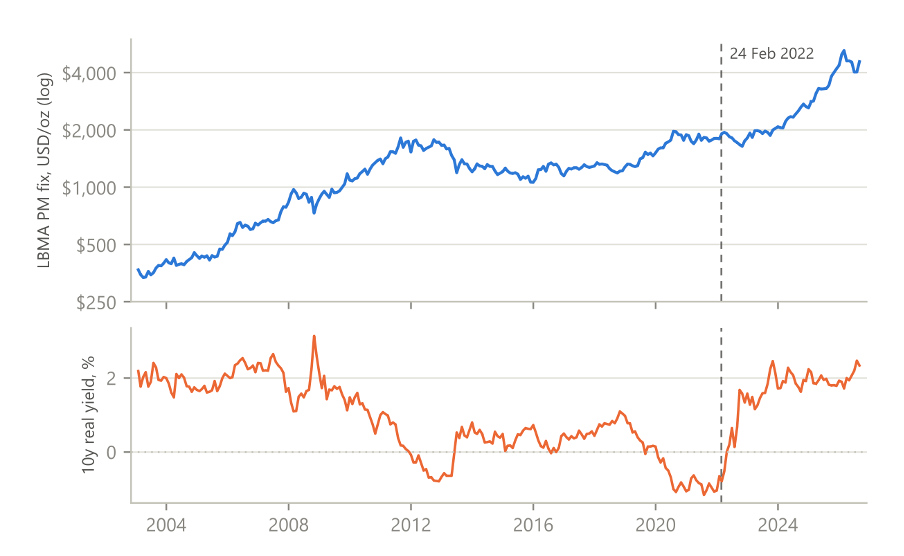
Gold soared to almost $5,500 per ounce at the very beginning of the year and held above $5,000 during February. Before 2022, the yield on a ten-year US government bond after inflation and the dollar explained most of the monthly variation in its price. But portfolio managers who extrapolated this model past the beginning of the Ukraine war obtained forecasts that became worse each month. At Quantitative Partners, we have been actively researching this phenomenon and trying to falsify the most common hypotheses on its origins.
The obvious explanation is war. Gold is the fear asset; the world became frightening; gold went up. The data does not support this. A standard academic measure of geopolitical risk, which counts how much major newspapers are writing about conflict, has no informative relationship with gold returns. None before 2022, none after. Not in daily data, not monthly, not in raw form or smoothed, not contemporaneously or with a lag. On the biggest geopolitical shock days in the past, gold's average move is even slightly negative. This holds for the era before and after the invasion of Ukraine.
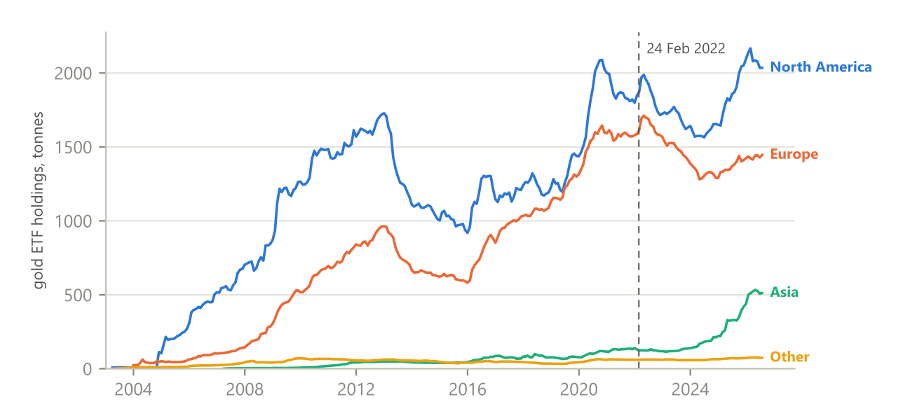
The second suspect is Western investors driving demand. However, gold exchange-traded funds in North America and Europe were net sellers right through 2022, 2023 and 2024, the years in which the price doubled. Private money only returned in 2025, as shown in the figure below, three years into the move and chasing the returns after they occurred. And hedge funds? Speculative positioning on the futures exchange averaged 22.4% of open interest before the break and 21.7% after. The price increase of gold cannot be traced back to parties in the visible markets.
The real force behind the rise has been more discreet. Central banks report their gold reserves to the IMF voluntarily, and many do not, or do so years late. Investigation of public gold trade behaviour must therefore rely on alternative approximations. The World Gold Council publishes two numbers: what central banks declare to the IMF, and an estimate of what they actually bought, reconstructed from customs data, refinery flows and vault intelligence. Metal that verifiably enters a country and never reappears in any private channel gets attributed to the official sector.
The difference between those two numbers hovered around zero for a decade. In 2022, the gap widened sharply and stayed at around 600 to 700 tonnes a year ever since. That is roughly a fifth of world mine production, bought every year by buyers who choose not to say so, starting in the exact year that $300 billion of global central-bank reserves were frozen by decree.
The phenomenon still appears in the current year's data. In the first quarter of 2026, central banks reported net purchases of 16 tonnes to the IMF. The estimate of what they actually bought was 244 tonnes.
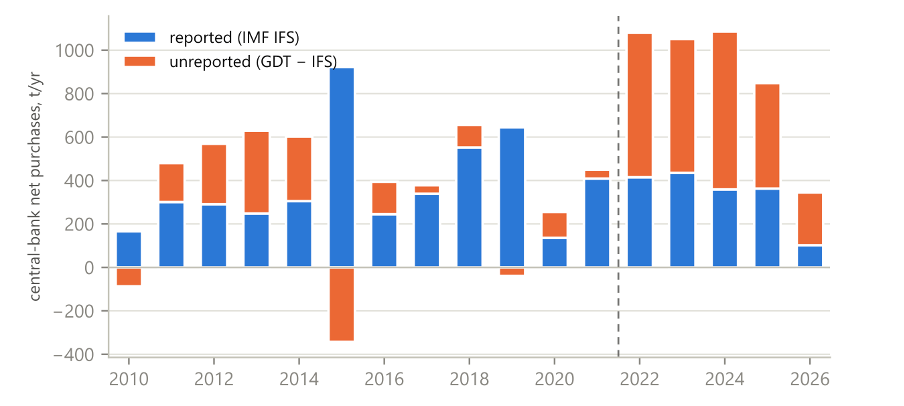
This introduces a new and quantitatively large component into the price of gold: official-sector demand, sitting on top of the well-known relationship with the dollar and the ten-year real yield that remains intact day to day and reappears at longer horizons once the new component is included in models.
The case is exemplary of a shift in the traditional rule set that regularly underpins portfolio management at family offices and smaller institutions. Failure to challenge models and assumptions periodically is likely to distort risk calibration and introduce undetected exposure and leverage effects into portfolios. Quantitative Partners does not work to prove established investment hypotheses, but to challenge them.
In the upcoming months, Quantitative Partners will publish the methodology and models it is already using with customers and partners in this specific case to enhance decision-making on gold as a portfolio component.