

The post-pandemic inflation shock has broken the stock–bond negative correlation that underpins the 60/40 portfolio: bonds no longer hedge equity drawdowns reliably.
For decades, the 60/40 portfolio (60% equities, 40% bonds) has been the cornerstone of mainstream capital allocation. Its logic rests on a single, historically reliable premise: stock returns and bond returns are negatively correlated. When equity markets fall, investors rotate into the safety of government bonds, pushing their prices up and cushioning portfolio losses. When equities rise strongly, bonds merely lag. In either case, the fixed-income allocation acts as a shock absorber. The subprime crisis and the decade of near-zero interest rates that followed reinforced this dynamic: risk-off episodes reliably sent capital flooding into fixed income, and the 60/40 split became an almost universal rule of thumb for balanced investors.
Inflation and the correlation regime shift
The post-pandemic economy has introduced a structural break in that assumption. A surge of fiscal stimulus, expansive monetary policy, quantitative easing, and the commodity shock of war in Europe drove US inflation above 8% in 2022 and Eurozone inflation above 10% by October of that year, levels not seen since the 1980s. The effect on fixed income was immediate and corrosive. A bond fund returning 2–3% is not merely lagging in a high-inflation environment; it is destroying real wealth. Even risk-averse investors found themselves forced to reach for higher-yield instruments or shift capital into equities simply to preserve purchasing power. The expectation that central banks will reliably anchor inflation at 2% is weaker than it has been in a generation.
The problem for the 60/40 framework is more structural than it first appears. Standard capital allocations have circled around this split for decades, 60% of capital dedicated to equities chasing growth, while 40% is allocated to mid- to long-term bonds. It has represented a reasonable option that exposes the majority of wealth to equity upside while remaining hedged by a sizeable allocation to more stable fixed income. The theoretical foundation for this split relies entirely on that negative correlation. Yet the 60/40 portfolio is already more volatile than many investors believe even under benign conditions. Introduce an inflationary shock, one that simultaneously pressures equity valuations and erodes the real value of bonds, and the logic of the hedge begins to unravel entirely.
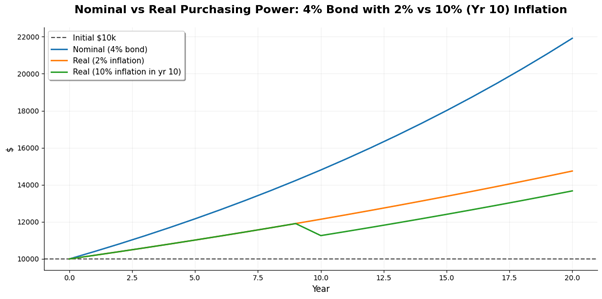
The chart above illustrates the problem directly: a single year of 10% inflation is enough to evaporate three years’ worth of real returns, directly harming the market value of a typical bond fund. The market’s aggregate response compounds the damage: if governments remain heavily indebted and unable to respond to crises without risking further inflation, interest rates must stay elevated, which means bonds and equities come under pressure simultaneously. The consequence is a profound shift in the relationship between the two asset classes: stocks and bonds are now positively correlated.
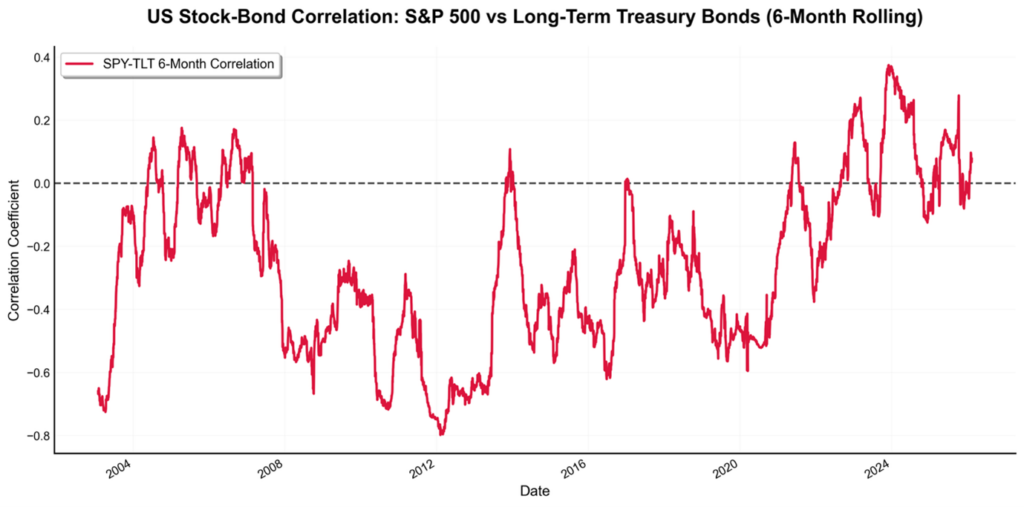
A 6-month rolling window correlation plot reveals this phenomenon has not occurred since 2013 and has not been observed stabile for an extended period since the years leading to the financial crisis. What is particularly striking is the magnitude of the shift: between 2008 and 2020, SPY-TLT correlations routinely reached –0.6 to –0.8 during risk-off episodes, precisely the hedging behaviour the 60/40 portfolio depends on. From 2022 onward, the correlation has not only turned positive but has repeatedly reached +0.3 to +0.4, levels that imply stocks and bonds are moving in near-lockstep. The brief returns to negative territory have been shallow and short-lived, suggesting each dip is a temporary repricing rather than a reversion to the old regime. For a 60/40 portfolio, this is the worst of both worlds: the bond allocation no longer offsets equity drawdowns, yet it still drags on returns during rallies.
Growing markets now come with a cost: the fear of underlying inflation. Part of the growth is the direct effect of public deficits, and a crash could trigger new easing policies that may render bonds insufficient to hedge against part of the losses. Thus, making the 60/40 portfolio just an inefficient option in the last couple of years. Losses are not dampened, and wins are hindered.
Donald Trump is very publicly antagonizing Jerome Powell, the Federal Reserve Director, precisely because of this. The president has explicitly argued that any market run as the US has experienced it during the beginning of his second mandate should correlate with lower interest rates that ultimately lead to even more capital allocation to the stock markets. The FED director has shown efforts to ensure that inflation expectations are anchored and do not spiral out of control again as this translates to costly financing.
The European case
The effect took longer to manifest in Europe. The energy crisis struck European economies right when monetary policy should have begun to tighten and kept the relation between the two asset classes more volatile.
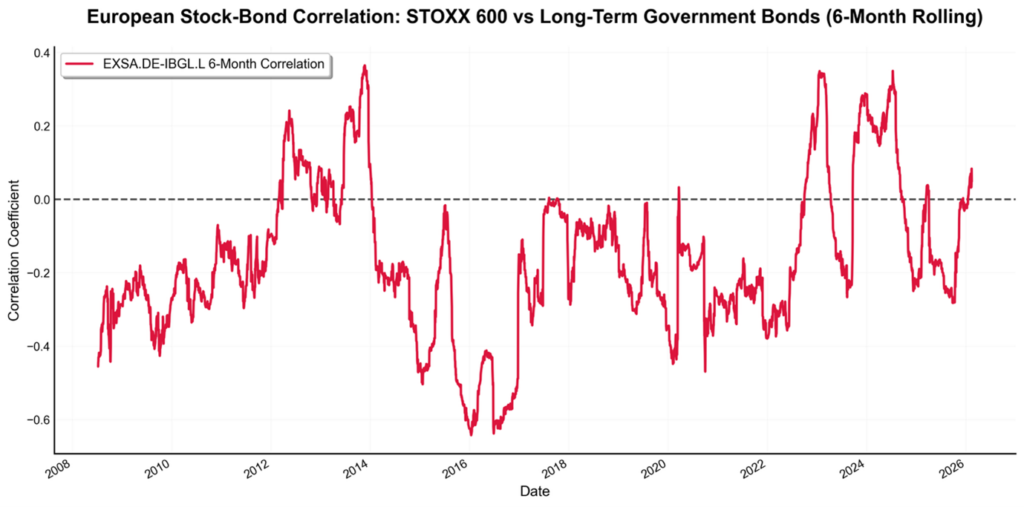
The European chart tells a more erratic but equally concerning story. Unlike the US, where the post-GFC period delivered a long stretch of deeply negative correlation, European stock-bond dynamics have been structurally noisier and the STOXX 600 vs. long-term government bond correlation oscillated between –0.6 and +0.3 even before the pandemic. This reflects the fragmented nature of European fixed income, where sovereign credit risk (particularly during the peripheral debt crises of 2011–2012) periodically drove bonds and equities down together. The 2022–2024 period, however, introduced something new: a sustained positive correlation driven not by idiosyncratic sovereign stress, but by a common inflation and rate shock across the bloc. During 2025, the positive correlation seemed to be dissipating, but heading into 2026, the correlation turned positive again while the Iran war is threatening to introduce equally durable energy price disruptions as the Russian invasion of Ukraine. While inflation was controlled in most Eurozone countries, there is clear unease across markets, coupled with a growing distrust in monetary systems and the dependency on foreign fossil fuels. The pattern is clear: each successive geopolitical energy shock re-ignites the positive correlation, and the intervals of negative correlation between shocks are becoming shorter and shallower.
Takeaways
These findings haven’t remained unnoticed: top firms like Blackrock have launched retail versions of their institutional quant alternatives funds, advertising precisely based on the presented market situation and betting on the regime shift to become a more pressing concern among retail investors and SFOs that now represent a substantial portion of the market.
For investors on both sides of the Atlantic, the implication is the same: the 60/40 portfolio is operating in a regime it was not designed for. Its core assumption, that bonds reliably cushion equity losses, has ceased to hold whenever inflation expectations are elevated. The case for strategies genuinely uncorrelated to both asset classes has rarely been more structurally compelling.
The good news is that this is an actionable problem. Calibrated quantitative alternatives (systematic strategies that harvest returns from momentum, carry, relative value, and volatility across asset classes) are designed to perform independently of whether stocks and bonds rise or fall together. These strategies have historically delivered their strongest risk-adjusted performance precisely in environments like the current one, where traditional diversification breaks down. What was once the exclusive domain of large institutional allocators is increasingly accessible: regulated UCITS-compliant vehicles now offer daily liquidity, transparent risk reporting, and minimum allocations that are realistic for single-family offices and high-net-worth portfolios. For SFOs re-examining their strategic allocation, the question is no longer whether alternatives deserve a place in the portfolio, but how much of the legacy bond allocation they should replace, and how quickly.